Pricing Transparency in 2026: Why Online Estimates Matter
For decades, service businesses have treated pricing as something to protect.
Prices were revealed late. Estimates were guarded. And websites were designed to generate calls and leads, not clarity.
That era is ending.
In 2026, pricing transparency is no longer a competitive risk. It is a competitive advantage.
And the businesses that adapt to this shift will win trust, higher‑intent leads, and better‑quality customers.
The forces reshaping pricing expectations
Several irreversible changes are colliding at once.
1. AI has trained customers to expect instant answers
ChatGPT, AI search, and automated assistants have rewired how people explore cost.
Customers now ask:
- “How much should this cost?”
- “What affects the price?”
- “Is this in my budget?”
…and they get immediate, structured guidance.
That conditions people to believe that pricing logic exists and that pricing insight should be accessible upfront.
When a website offers only “Contact us for pricing,” it now feels outdated, evasive, or high‑friction.
2. Google is elevating online estimates into the buyer journey
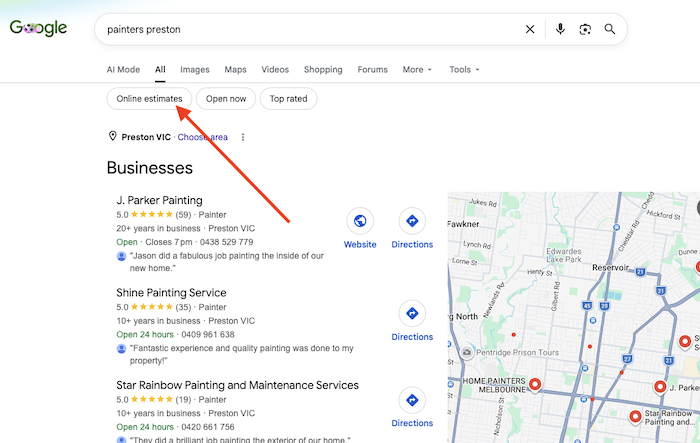
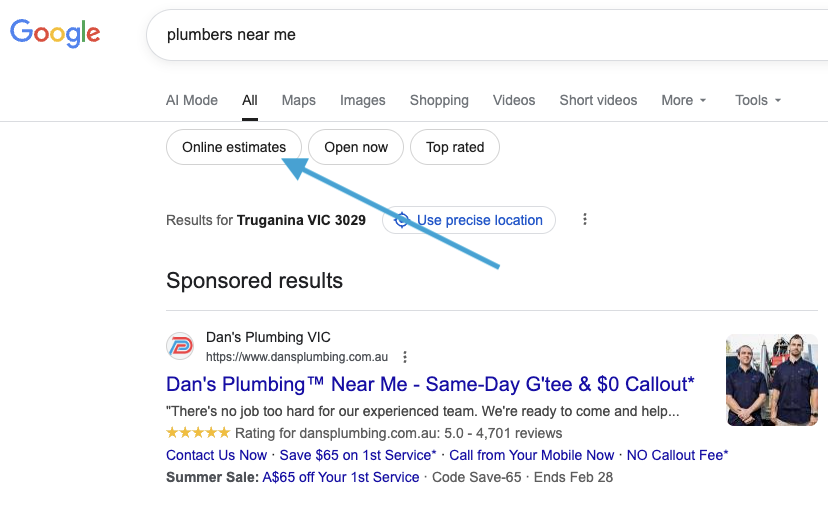
Google’s introduction of the “Online estimates” filter in local services search is not cosmetic.
It signals that:
- users actively want price guidance before contacting businesses
- rough estimates are considered useful and legitimate
- visibility will increasingly reward pricing readiness
In other words, online estimates are moving from optional conversion tools to search‑era necessities.
3. Buyers want orientation, not commitment
Modern customers are not asking for exact quotes online.
They want:
- realistic ranges
- explanations of cost drivers
- confidence that they are in the right ballpark
This distinction matters.
An estimate is not a quote. It is a decision‑support tool.
Businesses that provide this orientation reduce time‑wasting enquiries and increase the quality of inbound leads.
Why pricing transparency wins in 2026
1. Transparency filters out low‑intent leads
When customers see realistic estimates upfront:
- budget‑misaligned enquiries drop
- tyre‑kickers self‑disqualify
- serious buyers convert faster
This improves sales efficiency, not just conversion volume.
2. Transparency builds trust before the first conversation
People do not fear high prices. They fear surprises.
Clear estimates:
- reduce suspicion
- signal professionalism
- demonstrate confidence in your pricing model
Trust formed before first contact is one of the strongest predictors of close rate.
3. Transparency positions your business as modern
In a post‑AI world:
- slow pricing feels evasive
- vague pricing feels defensive
- instant pricing feels competent
Customers increasingly interpret a lack of pricing guidance as a sign that a business is behind the curve.
The common objections to pricing transparency
Despite the shift, many businesses still resist showing estimates.
Here are the most common objections from businesses, and why they no longer hold up.
Objection 1: “Every job is different. We can’t price online.”
This is true. It is also irrelevant.
Online estimates are not meant to replace site visits or final quotes.
They are meant to:
- model typical scenarios
- reflect known cost drivers
- produce ranges, not absolutes
Customers understand variability.
What they no longer accept is total opacity.
Objection 2: “What if the estimate is wrong?”
All estimates are wrong. That includes the verbal ones given over the phone.
The solution is not silence.
The solution is:
- disclaimers
- confidence bands
- clearly explained assumptions
When done properly, online estimates reduce misunderstanding rather than create it.
Objection 3: “Customers will anchor too low.”
Anchoring happens when pricing is vague or artificially optimistic.
Well‑designed estimators:
- include high‑end scenarios
- explain cost escalation factors
- show ranges, not single numbers
This sets more realistic expectations than ad‑hoc phone ballparks.
Objection 4: “Our competitors will see our prices.”
Your competitors already know roughly what you charge. Your customers do not. And customers are the audience that matters.
In 2026, secrecy signals insecurity.
Clarity signals confidence.
Objection 5: “This will commoditise our service.”
Commoditisation happens when services look identical.
Transparency actually does the opposite.
It gives you space to:
- explain your quality standards
- justify premium pricing
- differentiate based on scope, not mystery
Opaque pricing compresses everything into “cheapest wins.”
Transparent pricing lets value compete with price.
What pricing transparency actually looks like in practice
Pricing transparency does not mean publishing a static price list.
It means:
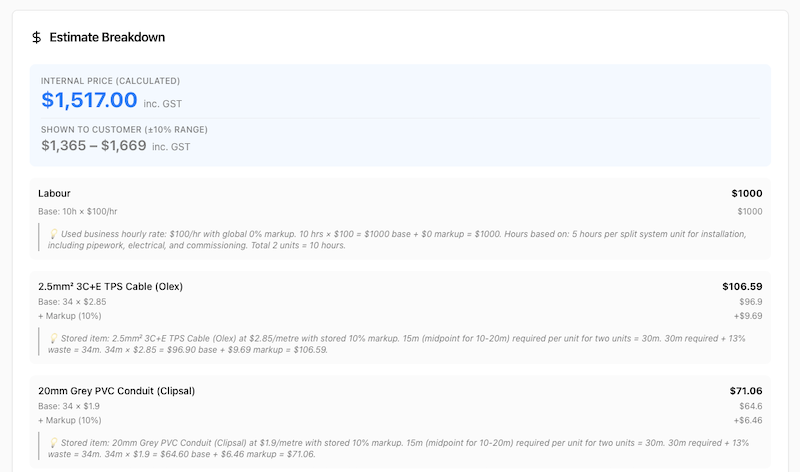
- interactive estimates
- explainable pricing logic
- clear ranges and disclaimers
- scenario‑based outputs
Modern estimator tools allow businesses to:
- adapt pricing to job inputs
- reflect regional differences
- account for material volatility
- update logic without rebuilding websites
This is not about giving everything away.
It is about showing that your pricing is principled, rational, and customer‑respecting.
The strategic shift businesses must make
The real change is not technical.
It is philosophical.
Pricing can no longer be treated as a gatekeeping device.
It must be treated as:
- a trust‑building tool
- a qualification layer
- a sales accelerator
In 2026 and beyond, the question is no longer:
“Should we be transparent with pricing?”
It is:
“How transparent do we need to be to stay competitive?”
Pricing transparency is not a trend.
It is the inevitable consequence of:
- AI‑driven expectations
- search platform evolution
- buyer behaviour shifts
The businesses that resist it will feel increasingly out of sync with how people buy.
The businesses that embrace it will:
- attract higher‑intent leads
- close faster
- and build trust before the first call.
In 2026, pricing transparency is the name of the game.