


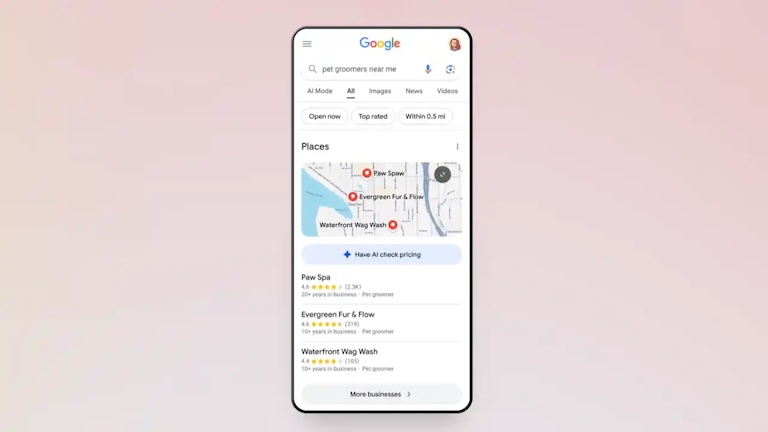
Over the past few weeks, some major changes have started appearing in Google’s local search results.
You may have noticed a new prompt “Have AI check prices” showing up directly in Google Business Profile listings. While they might seem subtle, they signal something much bigger happening behind the scenes.
Google is beginning to move beyond simply sending traffic to businesses. Instead, its AI is starting to act on behalf of consumers – gathering pricing, availability, and service details, then comparing businesses side-by-side before a customer even makes contact.
In other words, Google’s AI is becoming the shopper.
What’s actually changing?
Traditionally, the customer journey looked like this:
Search on Google
Click a website
Fill out a contact form
Wait for a callback or quote
Now, Google is experimenting with a very different model:
Customer searches
Google’s AI gathers pricing signals
Businesses are compared automatically
The customer sees recommendations before contacting anyone
This means fewer website visits, fewer form fills, and less opportunity to “sell” before a comparison happens.
Why pricing transparency suddenly matters more than ever
In this new model, clarity beats persuasion.
Google’s AI needs signals it can understand:
Price ranges
Service inclusions
Location-based costs
Consistency across website, GBP, and FAQs
If pricing isn’t visible or structured, Google will either:
Infer it from other sources, or
Prefer competitors who provide clearer signals
That’s why pricing pages, cost FAQs, and “How much does X cost?” content are no longer optional. They are becoming inputs for AI-driven decision-making.
The risk of staying opaque
Many trades and service businesses have historically avoided pricing on their website, often for good reasons. Every job is different, and no one wants to be locked into a fixed quote.
But AI doesn’t require fixed pricing. It works extremely well with:
Ranges
Estimates
Conditional pricing (“starting from”, “typically between”)
Businesses that provide some structure are easier for AI to understand than those that provide none.
If your pricing is inconsistent, or only lives in your head or your sales team’s scripts, AI will see that as uncertainty. And uncertainty rarely ranks well.
Where instant estimates fit into this shift
This is where instant pricing estimators start to play a bigger role.
An instant pricing estimator:
Structures pricing logic
Produces consistent ranges
Reflects real job variables
Creates machine-readable pricing signals
For consumers, it delivers instant answers.
For businesses, it creates clarity and control.
For platforms like Google, it provides reliable pricing data.
The bigger picture
This isn’t just a Google update. It’s a shift in how buying decisions are made.
We’re moving into an era where:
AI agents compare before humans do
Transparency beats persuasion
Businesses that communicate pricing clearly win earlier in the funnel
Don’t get left behind. Add an accurate instant pricing estimator to your website today to be prepared for this shift in Google’s algorithm.
Calculate How Aidtrade Could Grow Your Leads By 300% And More
To start, type in your current business metrics below, then hit ‘Calculate’. We recommend keeping the 'Instant Estimator Conversion Rate %' at 8% (based on industry averages).
Estimates are based on industry averages of a 2% conversion rate on generic contact us forms and an 8% conversion rate on an instant price estimator. Results may vary.